Money flex AI: the cash-fan video from a photo
Money flex AI is the October 2026 TikTok format where one photo becomes a 15-second vertical clip of someone hugging a chain of hundred-dollar bundles, swinging it over a shoulder, whipping it at the camera and fanning the bills across their own face in an ordinary bedroom. Most sites selling it copy a filmed performance onto your face with motion transfer, which is why their clip is 15 seconds and carries the trend’s audio. A prompt-based tool starts from your photo alone: no copied choreography, no trend audio, and a clip as long as the model will make.
What the money flex AI trend actually is
The clip is one unbroken take from a phone propped low on a dresser, in a bedroom with a ceiling fan spinning above the frame. The person hugs a ridiculous chain of banded hundred-dollar bundles to the chest, swings it up over one shoulder, whips the whole chain toward the lens so the bills flick past the camera, then rips the paper band off a single bundle and fans the notes out across the lower half of their own face. Deadpan throughout. About 15 seconds, vertical 9:16, posted silent or with the trend’s own sound added on TikTok.
It took off in October 2026. The first wave was Arabic-language and went by “all my money is cash”; English, Spanish and German remakes followed within days, and a dog version around 9 October pushed it past the niche it started in. CapCut templates list the same effect as “flaunting money”, “cash money AI” and the AI wealth trend, which is why the searches land in three or four different spellings: money flex, cash flex, money spread, cash fan.
Two different products sit under that one name, and the difference decides what you get. A template or motion-transfer tool copies a filmed performance — the movement, the timing, the room and the audio — onto the person in your photo, which is exactly why its output is 15 seconds. A prompt-based generator gets your photo and a written description, so the camera move, the room and the beats have to be described in words, and the length is whatever the model produces. Both are called “AI money flex”. Only one of them can copy the original shot.
Why the shot reads as a joke instead of a brag
The cash is obviously prop money and the delivery is deadpan, so the clip works as a joke about winning rather than a claim about wealth. That is the whole reason it travels: it is a reaction to send to the friend who split the bill last week, or a caption for payday, a first sale, a birthday. Nobody is meant to believe the money.
The moment people replay is the throw — the half-second where the frame is nothing but flying cash — and the punchline is the fan, because the bills cover the face instead of being held up for inspection. If you keep only one beat in a short clip, keep the fan.
Because the money is fake and the clip is synthetic, keep the AI label on when you post it, and never use the format to imply a real payout, a real investment or a real product. It is a costume, not a receipt.
The five beats, and what five seconds keeps
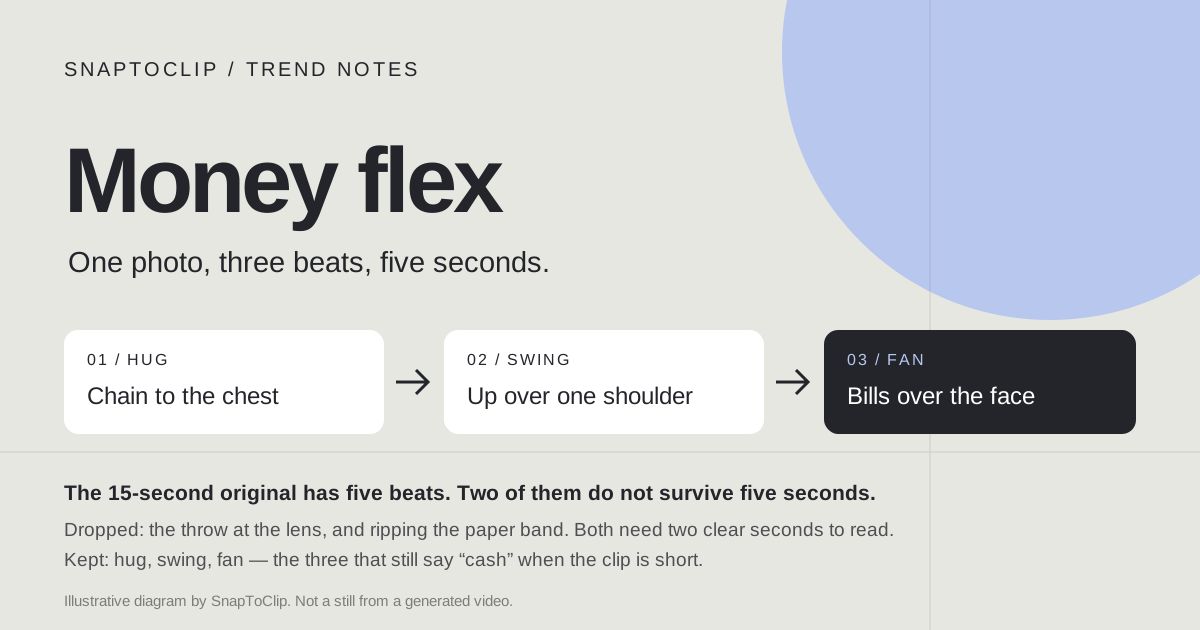
The original is a five-beat performance, and the published breakdowns of it agree on the order: hug, swing, throw, rip the band, fan. A 15-second clip fits all five with room to breathe. A five-second clip does not, and a prompt that lists all five produces a blur where every gesture is present and none of them lands.
The workable five-second version keeps three beats and drops two. Hug, swing, fan: the chain is already against the chest at frame one, it travels to the shoulder, and it opens into a fan at the lens. Drop the throw — it is the fastest movement in the shot and the one that most often smears hands and bills into a single grey smear inside five seconds — and drop the band-ripping, which needs its own two seconds to read.
This is the same prompt this site uses on its own prompt page for the format, and it is written for one photo rather than for a reference video, so it describes the room, the light and the camera instead of asking a model to copy anything.
| Beat | In the 15-second original | What a 5-second prompt keeps |
|---|---|---|
| Hug the chain | 0–4s: the chain is hugged to the chest, chin down, smug | Keep it as the opening frame |
| Swing to the shoulder | 4–6s: the chain goes up and over one shoulder | Keep it — it is the read that says “cash”, not “paper” |
| Throw at the lens | 6–9s: the chain is launched at the camera, frame full of flying bills | Drop it: the fastest movement, the biggest source of melted hands |
| Rip the band | 9–12s: one bundle is opened and flicked hand to hand | Drop it: needs two clear seconds to read |
| Fan across the face | 12–15s: bills open over the lower half of the face, deadpan eyes over the top | Keep it, and end on it |
The prompt to paste
The text below is written for a single photo: it names the room, the light, the camera height and the three surviving beats, and it ends on the constraints that keep a face and hands from drifting. Nothing in it refers to another video, because a one-photo pipeline has no reference video to point at.
“The adult in the reference photo stands behind a dresser in a bedroom with a slow ceiling fan overhead, filmed from a low phone angle, holding a long chain of banded hundred-dollar bundles folded like a fan. They curl the chain open against the chest, swing it up over one shoulder, then whip it toward the lens and fan the bills out across the lower half of the face with a smug deadpan look. Warm lamp light, handheld camera with a slight shake, vertical framing. Keep the face, hair and outfit consistent, with believable hands and consistent bundles. No added text or logos.”
If your model takes a shorter prompt, drop the sentence about light and camera shake before you drop the sentence about keeping the face consistent. Likeness is the thing viewers check first; the lamp light is the thing they forgive.
What photo works, and what wastes a credit
One adult, front-lit, with the face and both eyes clear. A half-body or waist-up shot is the sweet spot: the outfit carries the joke (the velvet jacket and the sunglasses pushed up on the head are half the reason the samples read as funny), and the arms need room to come up. A plain background is fine — the bedroom is generated, not copied from your photo.
What fails: group photos, because the model picks one face and invents the rest; sunglasses down over the eyes; heavy beauty filters, which flatten the skin the model then has to re-invent; photos where the hands are already cropped out, because the prompt asks for two hands full of cash; and any photo of someone who has not agreed to appear in a synthetic clip.
Pets do work in this format — the trend’s own breakout was a dog — but a paw cannot grip a paper band, so the fan and the rip are where pet versions fall apart. Ask for the peer-over-the-fan ending instead of a grip.
15 seconds, motion transfer, or five seconds: three routes
The price lists in this cluster look comparable and are not, because they are selling three different jobs. One copies a performance onto your face; one generates from your prompt; one makes the short version from one photo. Reading the length and the audio is enough to tell them apart.
Everything in the middle column is being read off public landing pages on 30 October 2026, and those numbers move. The point of the table is not the price — it is that “$4.99 for a 15-second clip” and “one credit for a five-second clip” are not two prices for the same thing.
| Template or motion transfer | Prompt from one photo | SnapToClip | |
|---|---|---|---|
| What it copies | A filmed performance: choreography, timing, room, audio | Nothing; it invents the room from your description | Nothing; a built-in look and your prompt |
| Length | Fixed, about 15 seconds | Whatever the model returns, often 5–12 seconds | Five seconds |
| Audio | The trend’s sound, carried from the source clip | Usually none, or added on the social app | Silent, or generated sound for a second credit |
| Cost shape | As sold per clip — one page prints $4.99 | Credits or a subscription, priced by resolution | One credit per silent clip, two with sound |
| What it is good for | Matching the trend beat for beat | Any scene you can describe | One photo, one vertical clip, today |
What goes wrong, and the sentence that fixes it
Extra hands or a third arm during the swing. The swing is the fastest thing in the prompt; shorten it to “lifts the chain over one shoulder” and it usually resolves, because “swing” invites the model to add motion blur and a spare limb.
The bills melt into a solid grey slab. Fanning hundreds of overlapping notes is the hardest texture in the shot. Ask for “banded bundles” and “a fan of bills” rather than “hundreds of bills”, and keep the fan for the final second instead of the whole clip.
The face stops looking like the person. This is the cost of a fast hand crossing in front of the mouth. Use a sharper, closer photo with both eyes visible, and regenerate before you change the prompt.
The chain reads as a paper towel roll. Prop money needs the printed edge to be visible. Name the object as “banded hundred-dollar bundles”, not “cash” — “cash” is what makes a model draw a blank roll.
Every gesture is present and none of them lands. That is the five-beat prompt inside five seconds. Cut to hug, swing, fan.
Common questions
Is the money real? No. It is generated prop money, and every site in this cluster says so somewhere. The format is a joke about showing off; using it to suggest income, a payout or an investment turns it into a trust problem and breaks the acceptable-use rules on every tool here.
Do I need the trend’s song? On TikTok or Reels, no file is needed — add the sound from the platform’s library when you post. That is also why the sample clips are silent: the audio was never part of the file.
Why is my clip shorter than the ones on other sites? Because the length comes from the method. A template replays a 15-second performance; a model generating from a prompt decides its own duration. Five seconds is a deliberate limit here, not a setting someone forgot to expose.
Can I make it with my dog? Yes, and the trend’s first breakout was a dog. Keep the ending — peeking over the fan — and drop the band-ripping, because paws cannot open a paper band.
Can I copy the original clip exactly? Not in a one-photo pipeline, and this site will not claim otherwise. Copying a performance beat for beat is motion transfer, which needs the source video as an input; the studio takes a photo and a prompt.
What does it cost here? One credit per five-second silent clip, two if you add generated sound, bought as one-time packs rather than a subscription. Check the studio for live availability before buying credits — generation is gated while rates are under review.
- Effect description, length, samples and $4.99 per clip — AI Money Flex (checked 30 October 2026) ↗
- Five-beat sequence and prompt guidance — Media.io money flex trend page (checked 30 October 2026) ↗
- Beat timings, credit prices and the 9 October dog version — MakeViral money flex template (checked 30 October 2026) ↗
- Motion transfer with a built-in performance clip, fixed 15-second output — trendai.video (checked 30 October 2026) ↗
- Arabic-first timeline and the CapCut template names — Slapclip money flex page (checked 30 October 2026) ↗
Find your scene.
Browse a template, then check creation availability in the homepage studio.
Explore the looks ↗